GCP-AI™
The Enterprise Velocity & Value Review
Organizations are spending millions on enterprise software, cloud transformations, and advanced artificial intelligence models. Yet corporate productivity indices tell a radically different story: decision latency is rising, middle-management bloat persists, and technical debt is consuming record shares of capital expenditures.
The problem isn't the technology itself. It's your organization.
When advanced AI engines or cloud systems are layered atop broken governance, fragmented data pipelines, and rigid operational workflows, they don't drive efficiency—they simply accelerate bad decisions.
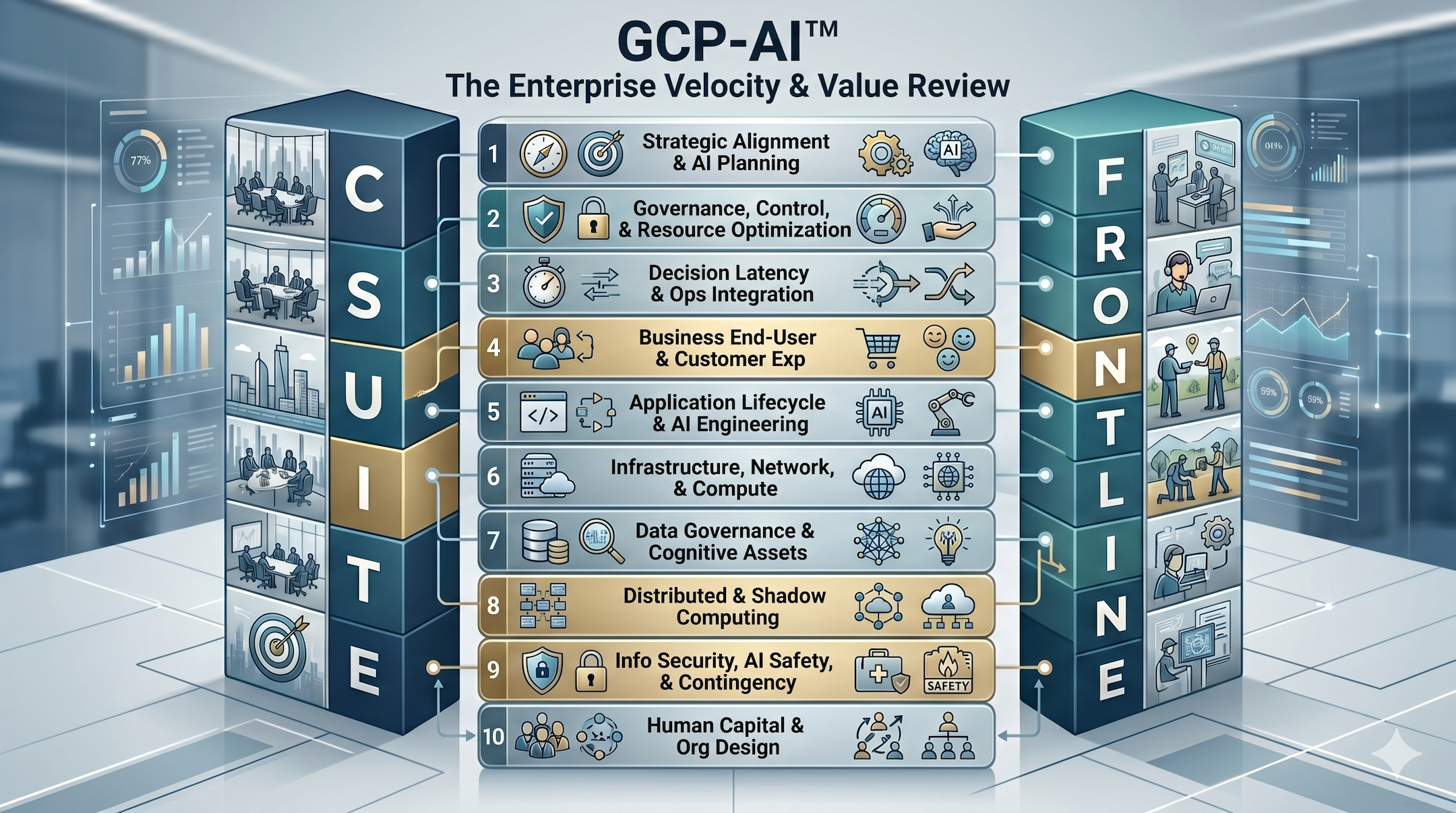
Our Two-Level (Executive & Deep Dive) Governance, Capability, & Project AI Resource Diagnostic, designed to be self-administered by your organization, identifies the exact structural, financial, and technical friction points that are preventing your organization from operating at maximum velocity.
This Review is Coming Soon!
Frequently Asked Questions (The Candor Check)
"Who leads and conducts this Review? Do we need to retain an expensive external consulting firm?"
No. This Review is explicitly designed to be self-administered. There is no need to hire expensive management consultants. Most organizations already possess capable leaders and internal talent who can successfully lead and deliver this Review.
Look for internal people with good consultative skills who are curious, think differently, and embrace disruptive change. Their prior experience may include management consulting at MBB or Big Four firms or leadership roles in start-ups, which means they are entirely comfortable interacting with CEOs and other senior leaders. These people are agile thinkers, generalizing specialists, and polymaths—high performers embracing AI as a force multiplier.
In almost all cases, AI levels the playing field between your internal teams and the traditional MBB and Big Four firms, democratizing access to advanced research, analysis, and execution tools.
"We already run regular IT audits and security compliance reviews. Why do we need this?"
Standard IT audits check boxes for server uptime and password compliance. They do not look at structural operational efficiency. They won't tell you if your software architecture is creating middle-management bloat, if your data pipelines are too messy to ground your AI engines, or if high decision latency is giving your competitors an advantage. This framework bridges the gap between technical infrastructure and enterprise strategy.
"How much time will this drain from my leadership team?"
We understand organizational fatigue. The Two-Level Review Architecture is explicitly designed to minimize executive time investment:
- Level 1 requires just a few highly structured, 45-minute alignment interviews with key leaders.
- Level 2 deep-dives happen entirely in the background, focusing on technical engineering discovery, code audits, and operational workflow mapping with functional teams.
"Our current focus is on cutting costs, not investing in new diagnostic consulting projects."
If you are trying to cut costs mindlessly, you risk cutting the muscle instead of the fat. This diagnostic directly addresses financial inefficiencies, such as unmonitored cloud spending, overlapping software platforms, and redundant management layers. By identifying these issues up front, the framework frequently pays for itself within the first 90 days of implementation.
The Strategic Case for a Self-Administered Internal Review
Choosing to self-administer this diagnostic framework rather than retaining expensive external management consultants provides significant structural advantages:
1. High-Velocity Talent Development
Appointing your highest-performing, AI-empowered internal talent to lead this review functions as an elite leadership development program. It gives your future executives comprehensive, cross-functional exposure to the organization's entire strategic, financial, and technical machinery.
2. Complete Institutional Knowledge Retention
When external consultants finish a project, their contextual insights leave with them. By conducting the review internally, the deep insights, architectural breakthroughs, and process nuances discovered during the Level 2 deep dives remain entirely within your walls. Your team retains the "muscle memory" needed to execute the remediation roadmap smoothly.
3. Radical Authenticity and True Ownership
External firms are often incentivized to tell executives what they want to hear or to stretch out the timeline to pitch downstream implementation services. An internal team has no such conflict of interest. Because they live in the organization's operational reality every day, they bring a level of radical authenticity to the scoring process that outsiders cannot replicate, establishing deep personal ownership in making those changes succeed.
4. Continuous, High-Engagement Culture
An externally driven audit can feel punitive to employees, often breeding defensiveness and resistance to change. Conversely, an internal review framed as a collaborative, cross-functional optimization exercise boosts employee engagement. It signals to your workforce that management trusts its own people to solve complex corporate challenges, fostering a proactive culture of continuous improvement.